Pan Am Southern; retro photos of a retro railroad; old tech in 2016.

Let’s gaze back in time; 30 plus years ago I was a young enthusiastic photographer with a 35mm Leica rangefinder. I was fascinated by the Boston & Maine, operated by Guilford Transportation Industries (as Pan Am Railways was then known).

B&M’s quaint operations, traditional signals, and antique General Motors diesels had a real appeal. Back then I focused on catching the EMD GP7s, GP9s, and GP18s, plus EMD switchers and run-through Delaware & Hudson Alco C-420s and C-424s.

I made hundreds of images trackside in those days.

On June 4, 2016, I picked up my old Leica, as I do from time to time, and loaded it with Ilford HP5 (often my choice film back in the day) and headed for Pan Am Railway’s East Deerfield yard before dawn, (as I have since I learned to drive 33 years ago).

Antiques still run the rails on Pan Am.

Pan Am Railways' SD40-2s at East Deerfield Yard on the morning of June 4, 2016.
Pan Am Railways’ SD40-2s at East Deerfield Yard on the morning of June 4, 2016.
A real rare pair in 2016; back to back high-hood GP40s. How sweet is that? This is Pan Am's EDRJ (East Deerfield to Rotterdam Junction).
A real rare pair in 2016; back to back high-hood GP40s. How sweet is that? This is Pan Am’s EDRJ (East Deerfield to Rotterdam Junction).

©Brian Solomon 582516

As the EDRJ was getting its train together the morning fog began to burn off. Cosmic light.

©Brian Solomon 582517

My lens of choice has a long history.

In the 1970s and very early 1980s, I’d often photograph with a Nikon 35mm wide angle made with a Leica screw-mount.

This lens had gone missing for decades and only recently re-emerged. In the interval it had seized up (as old equipment does when the lubrication dries out). My dad sent it for servicing and its now back in our arsenal of working photographic equipment.

Good lenses are relatively common these days. Most off the shelf digital cameras have pretty good optics compared with many consumer-grade film cameras of yesteryear.

But, truly great lenses remain hard to find.

This Nikon 35mm is a great lens. Not only is it sharp, lightweight and compact, but it has a distinctive optical quality that is rarely found with modern lenses. In short it has ‘that look.’ (look at the photos).

Pan Am's EDRJ roars upgrade through Shelburne Falls, Massachusetts passing an old Boston PCC streetcar that resides at the Trolley Museum.
Pan Am’s EDRJ roars upgrade through Shelburne Falls, Massachusetts passing an old Boston PCC streetcar that resides at the Trolley Museum. I used to ride these cars on the Riverside Line in the early 1970s.

After exposing my film, I processed it with the aid of a Jobo film processor to my own custom formula.

Basically, I used a twin bath developer of Kodak HC110 with constant agitation at 71 degrees F for 4 minutes, 15 seconds. Stopbath for 30 seconds; twin bath fixer; rinse; permawash; and final wash. Negs were scanned as TIF files using an Epson V600 flatbed scanner at 3200 dpi . Nominal contrast adjustment was necessary with Lightroom.

Undoubtedly, someone will ask, ‘but isn’t that a lot of work?’

Yes, it is.

And, ‘Couldn’t you just convert your digital files to black & white?’

 You could, yes.

And, so I ask, ‘do you have any favorites here?’

With a roar of 645 diesels and a cosmic cloud of exhaust, EDRJ approaches the east portal of the famed Hoosac Tunnel on the morning of June 4, 2016.
North Adams, Massachusetts.
The trees are taller at Eagle Bridge, but this station looks today much as it has looked for at least three decades. I've feature this in my book; Railway Depots, Stations and Terminals.
The trees are taller at Eagle Bridge, but this station looks today much as it has looked for at least three decades. I’ve feature this in my book; Railway Depots, Stations and Terminals.
Eagle Bridge, New York, the old Boston & Maine station is a relic of former times.
Railroading gone retro! Hooray!
Railroading gone retro! Hooray! Ilford HP5; f8 1/200th of a second.

Tracking the Light has new material every day.


Busy Day on Pan Am Southern’s West End—ten new photos.

I’ve said it before, I’ll write it again: If you don’t make the effort, you won’t get any photographs.

Yet, there have been many times where I’ve driven up the valley of the Deerfield River in western Massachusetts and was rewarded with only pleasant weather and fine scenery; not a bad thing, but . . .

On the morning of May 28, 2016, an early start allowed me to catch five trains between East Deerfield Yard and the Hoosac Tunnel.

My familiarity with this railroad and the terrain gave me the insights to act, while some clever driving allowed me to make the most of the opportunities that the railroad provided.

It helped to have fine Spring weather, which aided in creation of some satisfying images.

An empty auto rack train was tied down on the siding between Soapstone and East Portal. I exposed this view using my Lumix LX7 with the HDR setting that combines three images exposed in rapid succession and combines them. HDR infers 'high dynamic range', which is one tool available to digital photographers for working in high-contrast settings.
An empty auto rack train was tied down on the siding between Soapstone and East Portal. I exposed this view using my Lumix LX7 with the HDR setting that combines three images exposed in rapid succession and combines them. HDR infers ‘high dynamic range’, which is one tool available to digital photographers for working in high-contrast situations..
The East Portal of the famed Hoosac Tunnel.
I heard a whistle deep in the valley to the east. Curiously, this was a second empty auto rack train that was overtaking the train I'd photographed earlier. In the lead was Norfolk Southern 6900 which features a modern variation of the Safety cab. Exposed with my FujiFilm X-T1 at East Portal.
I heard a whistle deep in the valley to the east. Curiously, this was a second empty auto rack train that was overtaking the train I’d photographed earlier. In the lead was Norfolk Southern SD60E 6900 which features a modern variation of the Safety cab. Exposed with my FujiFilm X-T1 at East Portal.
I exposed this grab shot of NS SD60E 6900 as it roared by, moment before it entered the gloom of the tunnel. I adjusted the contrast in post-processing to make for a more pleasing image. Notice the profile of the locomotive cab.
I exposed this grab shot of NS SD60E 6900 as it roared by, moment before it entered the gloom of the tunnel. I adjusted the contrast in post-processing to make for a more pleasing image. Notice the profile of the locomotive cab. Panasonic LX7 Photo.
An eastward freight approaches East Portal.
Once a week Pan Am runs a unit clay slurry train from the connection with Vermont Rail System at North Bennington/Hoosick Falls to Maine. This often runs with Pan Am locomotives.
Once a week, Pan Am has run a unit clay slurry train from the connection with Vermont Rail System at North Bennington/Hoosick Falls to Portland, Maine (symbol NBPO). This day it was later than usual. (So I’m told).
Pan Am 617 leads the clay slurry train eastward at Charlemont, Massachusetts. Exposed with my FujiFilm X-T1.
While waiting for the clay slurry train, I was delighted to catch this westward move, Norfolk Southern symbol 11R that runs from East Deerfield to Enola, Pennsylvania.
While waiting for the clay slurry train at Shelburne Falls, I was delighted to catch this westward move, Norfolk Southern symbol 11R that runs from East Deerfield to Enola, Pennsylvania.
Trailing view of Norfolk Southern DASH9-40C 9258 at Shelburne Falls. (That's the Shelburne Falls trolley museum at the right).
Trailing view of Norfolk Southern DASH9-40C 9258 at Shelburne Falls.
I was looking for long sections of tangent track to best feature the effect of the clay slurry train which carries white tank cars full of clay used in the paper making process. Here I photographed it a Shelburne Falls (Buckland).
I was looking for long sections of tangent track to best feature the effect of the clay slurry train which carries white tank cars full of clay used in the paper making process. Here I photographed it a Shelburne Falls (Buckland). That’s the Shelburne Falls Trolley Museum at the right.

Omya_cars_Shelburne_Falls_DSCF8067

Norfolk Southern 11R was held at Buckland. The next siding (Soapstone-East Portal) was occupied by an empty auto rack train. The only eastward freight I'd seen was the once-per-week clay slurry train. 'Do the math' as they say; there must be another eastward freight! So I drove as fast as I could (with in legal parameters) back up to the east portal of the Hoosac Tunnel. I arrived about three minuted before Norfolk Southern 28N (loaded auto racks) exited the mountain. Not bad for one morning's effort! (PS, it isn't always this busy).
Norfolk Southern 11R was held at Buckland. The next siding to the west (Soapstone-East Portal) was occupied by an empty auto rack train. The only eastward freight I’d seen was the once-per-week clay slurry train. ‘Do the math’ as they say; there must be another eastward freight! So I drove as fast as I could (within legal parameters) back up to the east portal of the Hoosac Tunnel. I arrived about three minutes before Norfolk Southern 28N (loaded auto racks) exited the mountain. Not bad for one morning’s effort! (PS, it isn’t always this busy).

Tracking the Light posts every day.

Fitchburg Review: Pan Am, MBTA and New Signals—10 New Photos.

Continuing with yesterday’s theme of change on the Fitchburg Route, these photos were made on an exploration of recent investment along the old Boston & Maine line between Gardner and Ayer, Massachusetts.

In earlier Tracking the Light posts, I’ve focused on the old searchlights and other changes to the Fitchburg Route.

In May (2016) Rich Reed provided a detailed tour for Felix Legere, Paul Goewey and me, and we examined some of the new signals that have been installed, along with other changes, such as the construction of a new MBTA storage yard near Westminster, Massachusetts.

Panoramic composite view of MBTA's new storage facility near Westminster. Exposed with a Fuji XT1.
Panoramic composite view of MBTA’s new storage facility near Westminster. Exposed with a Fuji XT1.

Ultimately these improvements will facilitate expanded MBTA operations on the Fitchburg Line while enabling Pan Am freights to continue to share mainline tracks with commuter rail.

Photographing changes to railway infrastructure is challenging because often construction results in visual discordance. Broken ties, piles of ballast, and messy scenes resulting from digging and other work are hard to photograph in a meaningful way.

New signal bridge at Westminster. Exposed with a Fuji XT1.
New signal bridges at Westminster. Exposed with a Fuji XT1.
Pan Am Railway's freight EDPO (East Deerfield to Portland, Maine) crawls through the worksite at Westminster. Consider my use of foreground and background. Notice the old infrastructure and the new. Exposed with a Fuji XT1.
Pan Am Railway’s freight EDPO (East Deerfield to Portland, Maine) crawls through the worksite at Westminster. Consider my use of foreground and background. Notice the old infrastructure and the new. Exposed with a Fuji XT1.
Pan Am's EDPO at Wachusett; since I last made photos here the trees and underbrush have been cleared away and the cutting widened. Exposed with a Fuji XT1.
Pan Am’s EDPO at Wachusett; since I last made photos here the trees and underbrush have been cleared away and the cutting widened among other changes. Exposed with a Fuji XT1.
New signals on the move. Exposed with a Fuji XT1.
New signals on the move.
Exposed with a Fuji XT1.
Would this photo have been better on a clear day? Mind you I'd be looking into the noonday sun!
Would this photo have been better on a clear day? Mind you I’d be looking into the noonday sun! (I’m on the station platform on the northside of the line).
An outbound MBTA train approaches the Fitchburg Station.
Pan Am's POED (Portland to East Deerfield) roars west through Shirley. We learned that the new signals here illuminate when a train is coming from the opposite direction. Good to know!
Pan Am’s POED (Portland to East Deerfield) roars west through Shirley. We learned that the new signals here illuminate when a train is coming from the opposite direction. Good to know!
An MBTA HSP46 pushing the back of a Boston-bound train passes the new signal gantry at the Willows (east of Ayer, Massachusetts). Panned with a FujiFilm X-T1.

Tracking the Light posts daily.

New Book: Field Guide to Trains, Locomotives and Rolling Stock.

This afternoon (June 6, 2016) received my author’s advance copy of Field Guide to Trains, Locomotives and Rolling Stock published by Voyageur Press.

The book will be soon available from the publisher, as well as Amazon, Barnes & Noble, among other select bookstores and vendors.

In this compact 208-page soft-cover volume, I’ve covered a lot of ground by including not just modern mainline freight and passenger locomotives, but also historic engines, railroad rolling stock, as well as a sampling of light rail and heavy rail rapid transit cars.

Breda Light Rail cars glide along on a former Santa Fe Railway right of way in Los Angeles, California. This is the opening spread to the section on Rail Transit that covers chapters on Light Rail Vehicles and Heavy Rail Rapid Transit cars. I exposed this view in 2008 using my Canon EOS 3 and Fujichrome slide film. Many of the most recent images in the book were made digitally.
Breda Light Rail cars glide along on a former Santa Fe Railway right of way in Los Angeles, California. This photo is the opening spread for the section on Rail Transit that covers chapters on Light Rail Vehicles and Heavy Rail Rapid Transit cars. I exposed this image in Spring  2008 using my Canon EOS 3 and Fujichrome slide film. Many of the most recent images in the book were made digitally.

The high-quality photo reproduction impressed me.

I’ve dedicated the book to my friends Dan and Mary Howard.

In addition to my own photos, and those of my father’s and Dan’s, I’ve also included the work of contributing photographers including: Timothy Doherty, Chris Guss, Scott Lothes, Jack May, Tom Kline, Jim Shaughnessy, Patrick Yough, and Walter E. Zullig. The cover photo was supplied by Shutterstock.

This is the title page of my new book. My father exposed this classic view of Alco Road Switchers near 16th Street in Chicago on a trip there in June 1961. While most of the photos in the book are contemporary color views, I thought I'd spice up the content with a handful of historic photos. This one was made using a Rolleiflex Model T on black & white negative film. I've always like the semaphores at the far left.
This is the title page of my new book. My father, Richard Jay Solomon, exposed this classic view of Alco Road Switchers near 16th Street in Chicago on a trip there in June 1961. While most of the photos in the book are contemporary color views, I thought I’d spice up the content with a handful of historic photos. This one was made using a Rolleiflex Model T on black & white negative film. I’ve always like the semaphores at the far left. (Pardon the fold, I’ve scanned this directly from the book.)

In addition to basic technical descriptions, in my writing I’ve tried to put the different types of equipment in historical and developmental context, while illustrating the subjects using a variety of photographic styles. Many of the images are contemporary, but I’ve also included a few oldies from my father’s collection.

Thanks to everyone at Voyageur Press for their help in producing this fine looking book including my editor Todd Berger, project manager Alyssa Bluhm, art director James Kegley, and layout artist Amy Sly.

Special thanks to Steve Roth for helping to promote this book and for sending me my author’s advance copy!

Brian Solomon’s Tracking the Light is updated Every Day.

Photographing an Ethanol Extra at Gardner, Massachusetts.

A few weeks ago, my friends and I met to explore recent changes to the old Boston & Maine Fitchburg Route (Pan Am Southern’s main line) including re-signaling and trackage upgrades.

Among the first places on our tour was Gardner, Massachusetts, where we found Norfolk Southern 66N, which is a loaded Ethanol train destined for the Port of Providence.

This was led by four Norfolk Southern DASH9-40CWs that were followed by an idler car and 80 cars of ethanol. The train was waiting on Pan Am rails for a Providence & Worcester crew to take it south from Gardner.

Among the recent changes was the installation of a crossover at the Gardner yard that makes it easier to make a progressive move from the old eastward B&M mainline track to the P&W, which facilitates operation of unit trains such as the 66N. This is a low-tech solution, as the switches are operated manually (of the ‘hand-throw’ type).

I made this series of images featuring the 66N with my FujiFilm X-T1.

Static and slow moving freights offer many opportunities for photography.

When we arrived the morning was clear and sunny, but over the next hour, clouds rolled in from the west and softened the light.

The classic 'wedge' a three-quarter view of locomotives in low morning sun. Clutter from old ties and related track components is part of the scene, should these be cropped?
The classic ‘wedge’ a three-quarter view of locomotives in low morning sun. Clutter from old ties and related track components is part of the scene, should these be cropped? Although these GE’s are leading an ethanol extra, there is nothing in the photograph to indicate this is any thing other than an ordinary eastward freight.
Detailed vertical view of the leading engine, a General Electric DASH9-40CW.
Using the FujiFilm X-T1's panorama mode, I exposed this multi frame panoramic composite. This image was assembled automatically in-camera. The wide view offers an interesting perspective on the Gardner yard and the four GE locomotives.
Using the FujiFilm X-T1’s panorama mode, I exposed this multi frame panoramic composite. This image was assembled automatically in-camera. The wide view offers an interesting perspective on the Gardner yard and the four GE locomotives.
After about an hour of patient waiting, the P&W crew was on board and nearly ready to proceed south. I made this slightly elevated view from a parking lot on the site of the old Gardner Station. In the yard is one of P&W's leased SD60s and some auto racks for interchange.
After about an hour of patient waiting, the P&W crew was on board and nearly ready to proceed south. I made this slightly elevated view from a parking lot on the site of the old Gardner Station. In the yard is one of P&W’s leased SD60s and some auto racks for interchange. Unfortunately, the auto racks block the view of the ethanol tanks. Note the crossover that links the old eastward mainline with the tracks in the P&W yard.
Norfolk Southern 66N takes the switch on to the P&W at Gardner.

NS_66N_Ethanol_extra_Gardner_Yard_DSCF7673

Trailing view of the leading locomotive easing down the P&W toward the Route 2 underpass.
Trailing view of the leading locomotive easing down the P&W toward the Route 2 underpass. Soft light is excellent for showing detail on a largely black locomotive. This photo was made in Gardner, yet it could be almost anywhere.
Trailing view of NS 66N on the P&W at Gardner.
Trailing view of NS 66N on the P&W at Gardner. The 80 tanks make for a rolling pipeline. How many gallons of ethanol does this train carry?

Thanks to Rich Reed, Paul Goewey and Felix Legere.

Tracking the Light Posts Daily.

Berkshire Scenic RDC at Renfrew, Massachusetts—Real black & white.

Yesterday (Saturday June 4, 2016) I exposed this view of Berkshire Scenic’s RDC using my old 35mm Leica 3A rangefinder. I processed the film this morning and scanned it for internet presentation.

Coming up soon, I’ll detail specifically what I did and why.

©Brian Solomon 582544Tracking the Light posts daily.


For details on Berkshire Scenic’s Hoosac Valley service which is now running out of North Adams, Massachusetts see: http://www.hoosacvalleytrainride.com

Also see Berkshire Scenic Railway on Facebook:

https://www.facebook.com/berkshirescenicrailway

Old Gatwick Express at Clapham Common.

To improve this image, I’ve cropped distracting and unsightly elements (boxes and graffiti) from the left and the right hand sides of the frame.
To improve this image, I’ve cropped distracting and unsightly elements (boxes and graffiti) from the left and the right hand sides of the frame. Exposed on Fujichrome and scanned with a Nikon LS-5000.

On 25 March 2007, Hassard Stacpoole and I were photographing the evolving British railway scene in the London area. Among our subjects for the day were the specially styled Gatwick Express class 460 Juniper train sets, such as this one, and Eurostar trains working via 3rd rail and serving London Waterloo International.

While the core of old Gatwick trains still exist, the distinctive styling was removed.

We knew then that both services would eventually change. The Gatwicks  services were re-equipped while the Eurostar was routed into St. Pancras.

Tracking the Light Posts Daily.

York at Speed: Pan view of a GNER HST.

I used my Nikon F3T with a 105mm Nikkor lens loaded with Fujichrome. To achieve the sense of motion, I panned the front of the HST while using a comparatively slow shutter speed (about 1/30th of a second). The key to a successful pan image is to start panning well-before pressing the shutter and continuing the pan motion after the shutter has been released.
For this view, I used my Nikon N90S with a 105mm Nikkor lens loaded with Fujichrome. To achieve the sense of motion, I panned the front of the HST while using a comparatively slow shutter speed (about 1/30th of a second). The key to a successful pan image is to start panning well-before pressing the shutter and continuing the pan motion until after the shutter has been released. Turn your whole body and not just the camera.

I exposed this panned view of a GNER HST on the East Coast Mainline near the York station in December 1999.

A similar photo appeared in my book Railway Masterpieces published by Krause Publications in 2002.

Tracking the Light Posts Daily.

Southern Pacific Siskiyou Line Sunset

Southern Pacific through freight RVME-M arrives at Medford, Oregon on the evening of May 11, 1990. Exposed on Kodachrome 25 using a Nikon F3 with f2.0 135mm lens.
Southern Pacific through freight RVME-M arrives at Medford, Oregon on the evening of May 11, 1990. Exposed on Kodachrome 25 using a Nikon F3 with f2.0 135mm lens. Slide scanned with a Nikon LS-5000 at 4,000 dpi and processed with Lightroom to remove dust.

I exposed this view of Southern Pacific’s RVME-M (Roseville to Medford, Manifest) arriving at Medford, Oregon.

This was one of many Kodachrome slides exposed on an exceptionally productive trip to SP’s Siskiyou Line with Brian Jennison in May 1990.

For more Siskiyou photos, click HERE to see my earlier post.

Tracking the Light Posts Daily.

Brian’s Field-Finder Cab-View of a Soviet Electric.

To see the full image click on Tracking the Light.

In July 2002, I spent a week in Estonia photographing railway operations.

It was organized for me take a cab-ride on an empty oil-train in a recently imported former Union Pacific General Electric C36-7 diesel.

I wrote about this adventure in my recently published book The World’s Most Exotic Railway Journeys produced in the UK by John Beaufoy Publishing Limited. (Available on Amazon).

I was working with three cameras. Previously I’ve published color views exposed with my Contax G2 rangefinder and Nikon N90S single-lens reflex, however until today most of my  black & white photos remained unpublished and unseen.

I made  my black & white photos using  a Rollei Model T twin-lens reflex (120 size film camera). So, rolling along at about 30 mph east of Tallinn, I made this view of a Riga-built Tallinn-area electric suburban train.

Exposed with a Rolleiflex Model T twin-lens reflex fitted with a 75mm Zeiss Tessar. Kodak Tri-X processed in Ilford ID-11 1:1 with water. Scanned at 3200 dpi with a Epson V600 flatbed scanner. Scaled for internet presentation using Lightroom; however there was no post-processing manipulation to density, contrast or sharpness.

Significantly,I made this image by using the Rollei’s field-finder— which is nothing more than a pair of open squares that allow you to frame up a photo while holding the camera at eye-level.

Normally, I’d focus using the camera’s built in magnifying glass on the waist level viewer (which supplies a view through the top lens arrangement that projects onto a Fresnel screen. The down side of this viewing mechanism is that you must look down into the camera and the image is in reverse.

So exposing photos from a moving locomotive cab using the waist-finder is not only impractical, but can lend to sea-sickness.

Another advantage of the field-finder is that you are actually looking at your subject without any distortion caused by a lens. In today’s photography it rare that you actually see your subject at the time the shutter is released. You’d be amazed how this direct viewing can improve composition.

Also, the Rollei’s mechanical shutter release is virtually instantaneous.

Tracking the Light Posts every day.


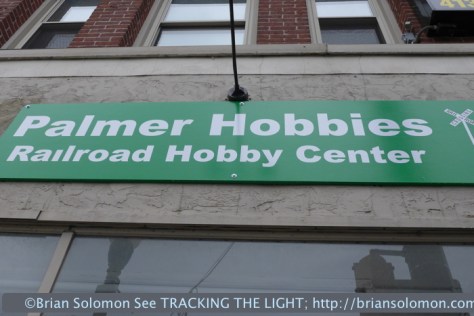
Palmer Hobbies Second Anniversary!

Today marks the second anniversary of the opening of Palmer Hobbies in Palmer, Massachusetts.

Located on Main Street, just a block from the famous Palmer diamond—where the New England Central crosses CSXT’s former Boston & Albany.

See: http://www.palmerhobbies.com

www.palmerhobbies.com
New products for viewing.
Palmer Hobbies is prominently located on Main Street. Come in and read their magazines!

Bill_and_Rich_P1470932

Thanks to Doug Moore for reminding me of the correct anniversary day.

Tracking the Light Posts Daily.

Monson Tornado-Five Years Ago; Ten Original Photos [click on Tracking the Light to see all images]

See: http://briansolomon.com/trackingthelight/

It was five years ago today—June 1, 2011—when extremely unusual weather conditions produced a tornado that swept through Monson, Massachusetts and surrounding towns.

I’d just returned from Dublin a few days earlier.

I made a few photographs of the storm from my window on Moulton Hill Road. I only glimpsed the funnel for a few moments and the passage of the storm was remarkably quick.

Funnel cloud Monson, 4:55 pm June 1, 2011. Photograph by Brian Solomon with Lumix LX3 digital camera.
Tornadic sky, Monson, Massachusetts shortly before 5pm on June 1, 2011. Lumix LX3 photo.

Fortunately for us the funnel missed Moulton Hill by about 2 miles. Many others were not so lucky.

On June 3, 2011, I ventured into the village and made photographed evidence of the most extreme damage.

National Guard patrols Main Street Monson on June 3, 2011.

Dozens of buildings in town were destroyed and many thousands of trees were ruined. The event made national and international news.

These photographs are intended as a document of the event and its aftermath as I witnessed it and do not represent an interpretation of the storm nor complete record of its destruction.

First Church, Monson on June 3, 2011.
Destruction on Washington Street, Monson on June 3, 2011.
Ruined buildings on Washington Street, Monson on June 3, 2011.
Tornado damage, Monson on June 3, 2011.
Monson on June 3, 2011.
Tornado damage in Monson as seen on June 3, 2011.

Brian Solomon’s Tracking the Light Posts Daily

Exploring Historic Railways of Cork-Two Dozen Unique Images.

Cork’s railways were once vastly more complex than they are today.

Over a three-day span beginning 7 May 2016, I was given a thorough tour of Cork’s historic railways that included: a walking tour of the route of the old Cork City Railway; a cycle tour of the route of the Cork, Blackrock & Passage; and a detailed look at the numerous railway terminals that once served this southwestern Irish city.

I made numerous photographs composed to document railway settings as they are today. In many instances service was discontinued decades ago and the lines lifted and so the role of the railway is more conceptual than literal.

Thanks to Ken Fox, Donncha Cronin, Brian Sherman, Kevin Meany and Richard Lee for their expert guidance and historical knowledge.

I arrived by Irish Rail's Mark4 from Dublin. This view of Cork's Kent Station (Glanmire Road) was made from the foot bridge over the right of way of the line to the old Summer Hill Station.
I arrived by Irish Rail’s Mark4 from Dublin. This view of Cork’s Kent Station (Glanmire Road) was made from the foot bridge over the right of way of the line to the old Summer Hill Station. I featured Kent Station in my book Railway Depots, Stations and Terminals.
I've always liked Kent Station's Victorian-era curved train shed. Exposed with a FujiFilm X-T1 digital camera.
I’ve always liked Kent Station’s Victorian-era curved train shed. Exposed with a FujiFilm X-T1 digital camera.
Irish Rail 201-class diesel 220 at Kent Station Cork on 7 May 2016. Lumix LX7 photo.
Old footpath over the line to Summer Hill Station.
Old footpath over the line to Summer Hill Station. Kent Station is 180 degrees behind this view.
Site of Summer Hill station that once handled trains working the line toward Cobh.
Detail of the iron work on the foot bridge near Summer Hill station.
Kent Station viewed from the Glanmire Road bridge. The earlier Penrose Quay station was located to the right of the curved shed.
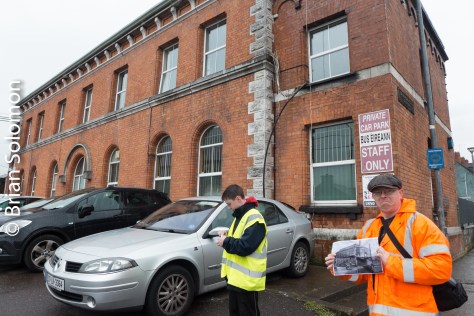
Donncha Cronin hold a vintage photo of the Capwell Station at the old station building (now used by a Bus Eíreann maintenance depot).
Donncha Cronin holds a vintage photo of the Capwell Station at the old station building (now used by a Bus Eíreann maintenance depot). Historically, Capwell was the terminus for the Cork & Macroom Railway.
Panoramic composite of the old Capwell Station.
Panoramic composite of the old Capwell Station (centre).
Old railway gate at the site of Cork, Blackrock & Passage's Albert Road Station. Lumix LX7 photo.
Old railway gate at the site of Cork, Blackrock & Passage’s Albert Road Station. Lumix LX7 photo.
Cork, Blackrock & Passage Railway's Albert Road Station.
Cork, Blackrock & Passage Railway’s Albert Road Station.
The former offices for the Cork, Bandon & South Coast Railway near Albert Quay in Cork City.
Quayside trackage on the Cork City quay.
Right of way of the old Cork City Railway.
Perhaps the last vestige of track relating to the Cork City Railway located near Albert Road in Cork.
Perhaps one of the last vestiges of track relating to the Cork City Railway located near Albert Road in Cork.
Perhaps the last vestige of track relating to the Cork City Railway located near Albert Road in Cork.
Perhaps one of  the last vestiges of track relating to the Cork City Railway located near Albert Road in Cork.
The old train staff that had been used to authorize train movements on the Cork City Railway. Photo courtesy of Kevin Meany.
Site of the old Western Road station (now a hotel).
Cork, Blackrock & Passage was originally a broad gauge line, later converted to a largely double track 3 foot gauge suburban railway (similar in concept to the Boston, Revere Beach & Lynn). Now a popular urban cycle path.
Cork, Blackrock & Passage was originally a broad gauge line, later converted to a largely double track 3 foot gauge suburban railway (similar in concept to the Boston, Revere Beach & Lynn). Now a popular urban cycle path, seen here at Blackrock.
Site of Blackrock Station on the Cork, Blackrock & Passage Railway.
Near Monkstown Station on the Cork, Blackrock & Passage Railway.
Near Monkstown Station on the Cork, Blackrock & Passage Railway right of way.
Ken Fox studies a sign illustrating the history of the Cork, Blackrock & Passage.
Ken Fox studies a sign illustrating the history of the Cork, Blackrock & Passage at Carrigaline, Co. Cork.
A sign illustrating the history of the Cork, Blackrock & Passage at Carrigaline, Co. Cork.
Site of the Crosshaven terminus of the Cork, Blackrock & Passage suburban narrow gauge.
Irish Rail's footbridge at Glounthaune Station. Lumix LX7 photo.
Irish Rail’s footbridge at Glounthaune Station. Lumix LX7 photo.
Glounthaune Station.
An Irish Rail 2600 passes the old container terminal at North Esk, last served by Irish Rail in summer 2005.
An Irish Rail 2600-series railcar passes the old container terminal at North Esk, last served by Irish Rail in summer 2005.

Tracking the Light posts Daily.


Sunrise on the old Western Rail Road; Middlefield, Massachusetts.

Since 1841, the rails of the old Western Rail Road (later Boston & Albany, and for the time-being CSXT’s Boston Line) have served as a conduit of commerce through the Berkshire Hills of western Massachusetts.

I made this photograph at sunrise using my FujiFilm X-T1 fitted with a Zeiss 12mm Touit lens and a graduated neutral density filter to control contrast.

My friend Mel Patrick has often posed the question: ‘must all railroad photos show trains?’

Exposed in May 2016 using FujiFilm X-T1 digital camera with 12mm Zeiss lens.

Tracking the Light posts daily.


This Budd Could Be For You!

—For ten NEW photos, click on Tracking the Light—

Brian Solomon’s Tracking the Light Posts Daily.

Berkshire Scenic Railway Museum’s Hoosac Valley Service is operating with a vintage Budd-built Rail Diesel Car.

Berkshire_Scenic_RDC_DSCF8093

Lumix LX7 photo.
Lumix LX7 photo.

Budd Company’s RDC made its debut in 1949 and was first used in regular revenue service on New York Central’s Boston & Albany in 1950.

I made these views of Berkshire Scenic’s RDC on the former Boston & Albany North Adams Branch yesterday, May 28, 2016.

Berkshire Scenic plans to operate this car on weekends and select public holidays between Memorial Day and Labor Day. For details see: http://www.hoosacvalleytrainride.com/schedule.php

Also see Berkshire Scenic Railway Museum on Facebook.

https://www.facebook.com/hoosacvalleyservice

Berkshire Scenic's new North Adams station area. Exposed with a FujiFilm X-T1; contrast adjusted in post processing.
Berkshire Scenic’s new North Adams station area. Exposed with a FujiFilm X-T1; contrast adjusted in post processing.

Want to learn more about Budd’s RDC and other classic streamlined trains? Check out my new book: Streamliners—Locomotives and Trains in the Age of Speed and Style published by Voyageur Press.

A Budd with a view! FujiFilm X-T1; contrast adjusted in post processing.


Looking southward on the old B&A branch. At one time Boston & Albany's North Adams Branch connected its namesake with Pittsfield. As late as the 1940s, through trains operated fro Grand Central Terminal to North Adams using the Harlem line to Chatham and B&A mainline to Pittsfield.
Looking southward on the old B&A branch. At one time Boston & Albany’s North Adams Branch connected its namesake with Pittsfield. As late as the 1940s, through trains operated fro Grand Central Terminal to North Adams using the Harlem line to Chatham and B&A mainline to Pittsfield.
Berkshire Scenic's RDC departs North Adams for Renfrew on May 28, 2016. FujiFilm X-T1; contrast adjusted in post processing.
Berkshire Scenic’s RDC departs North Adams for Renfrew on May 28, 2016. FujiFilm X-T1; contrast adjusted in post processing.
Berkshire Scenic's RDC departs North Adams for Renfrew on May 28, 2016. FujiFilm X-T1; contrast adjusted in post processing.
Berkshire Scenic’s RDC departs North Adams for Renfrew on May 28, 2016. FujiFilm X-T1; contrast adjusted in post processing.
Where else does the old Boston & Albany cross below the old Boston & Maine? Here we have trains top and bottom.
Where else does the old Boston & Albany cross below a route of the old Boston & Maine? Here we have trains top and bottom.
Tickets!
Tickets!

Berkshire_Scenic_RDC-1_at_North_Adams_DSCF8105

Berkshire Scenic Railway’s RDC-1 is on the roll Memorial Day Weekend

Saturday May 28, 2016, I rode and photographed Berkshire Scenic Railway’s RDC-1 on the former Boston & Albany North Adams Branch. (More RDC photos see: This Budd Could Be For You!)

On Saturday May 28, 2016, Berkshire Scenic Railway's classic RDC-1 worked between North Adams and Renfrew, Massachusetts on the old Boston & Albany branch. Exposed with a FujiFilm X-T1; contrast adjusted in post processing.
On Saturday May 28, 2016, Berkshire Scenic Railway’s classic RDC-1 worked between North Adams and Renfrew, Massachusetts on the old Boston & Albany branch. Exposed with a FujiFilm X-T1; contrast adjusted in post processing.

Last autumn my dad and I rode this classic railway vehicle, but at that time it was being hauled/propelled by a vintage SW8 diesel. Saturday, I found the RDC-1 running as intended as a self-propelled diesel rail car.

I recalled riding RDCs on the Springfield-New Haven shuttle back in the 1970s and 1980s, and on Metro-North branch line trains, as well as Boston area service.

For details on Berkshire Scenic’s Hoosac Valley service which is now running out of North Adams, Massachusetts see: http://www.hoosacvalleytrainride.com

Also see Berkshire Scenic Railway on Facebook:

https://www.facebook.com/berkshirescenicrailway

Brian Solomon’s Tracking the Light Post Every Day!

Belfast-Dublin Enterprise arriving Connolly Station.

Recently the cross-border Enterprise service operated by Irish Rail and NIR has undergone an image upgrade.

In early April 2016, I made these images a revamped Enterprise set with engine 207 arriving at Connolly Station in Dublin.

Exposed using a FujiFilm X-T1 mirrorless digital camera.

Enterprise_207_at_Connolly_DSCF2984

Tracking the Light is Daily.

Tracking the Light presents: London Terminals—May 2016; a Dozen new Photos.

London boasts some of the most historic and most famous big city railway terminals.

Earlier this month I visited several of these stations during the course of my travels.

Soon Euston may be dramatically redeveloped. Yet, owing to its 1960s design, this terminal may be among the least photographed in modern times. FujiFilm X-T1 photo, May 2016.
Euston Station, London.
Departure boards at London Euston in May 2016. FujiFilm X-T1 photo, May 2016.

Hassard Stacpoole brought me on a tour of London’s 1960-era Euston Station to show me sites of anticipated changes to this busy terminus as result of its planned redevelopment.

My favorite London station is St. Pancras. Which is yours?

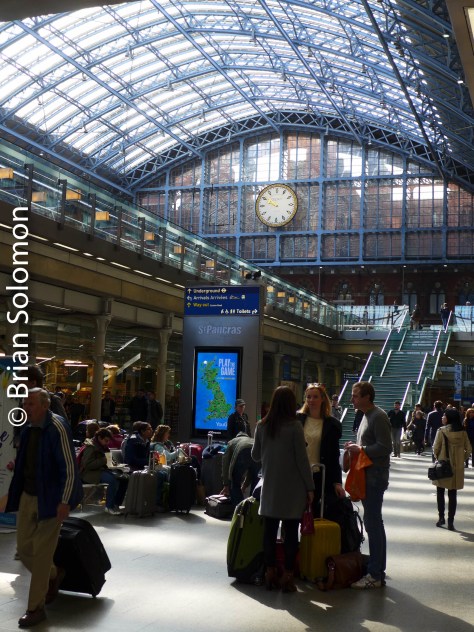
The most elegant and ornate London terminus is St. Pancras. The head house originally served as the Midland Grand Hotel as well as booking offices. Today the grand old building is again a hotel, while the station serves Eurostar trains to Paris, Lille and Brussels as well as domestic services using the old Midland route. FujiFilm X-T1 photo with Zeiss 12mm lens, May 2016.
St. Pancras train shed was restored during redevelopment in 2007. FujiFilm X-T1 photo with 12mm Zeiss lens, May 2016.
Kings Cross, London, May 2016. Lumix LX7 photo.
Grand Central train at Kings Cross, London, May 2016. Lumix LX7 photo.
Statue of Isambard K. Brunel at Paddington Station, London. Lumix LX7 photo.
Paddington Station, London. Lumix LX7 photo.
London Victoria on a quite Sunday morning. Lumix LX7 photo.
London Victoria on a quiet Sunday morning. Lumix LX7 photo.
I feature several of London’s stations in my recent book Railway Depots, Stations and Terminals published last year by Voyageur Press.

Tracking the Light posts daily.

All Change! Photographing trains and Clapham Junction and Vicinity—May 2016.

On my visit to London earlier this month, I called into Clapham Junction to visit with my friend Hassard Stacpoole who lives nearby.

Hassard brought me on a tour of the area to highlight the changes south of the Thames since my last visit.

London is a dynamic city. There are cranes and construction sites everywhere you look.

The area around Battersea Park is rapidly being transformed from an old industrial area to a modern residential community.

Using my FujiFilm X-T1 and Lumix LX7, I made these photos from our tour of the area.

Five car Overland trains now serve Clapham Junction.
Five car Overground trains now serve Clapham Junction.

My intention is to compare these images with similar views exposed years ago, as well as photos showing further change from my next visit.

FujiFilm X-T1 digital photograph at Clapham Junction.
Clapham Junction.
Clapham Junction.
Wandsworth Road looking toward Battersea Park. Construction now dominates this horizon.
The old Battersea Park Generating Station is being repurposed.
Massive modern apartment blocks have sprung up around Battersea Park like mushrooms after the rain.
Transportation changes are part of the story.
Thames bridge on approach to Victoria. Look at all the new building underway.
Looking south from Victoria toward Battersea Park.
Looking south from Victoria toward Battersea Park. Here the background is the subject.
In London little remains unchanged for long. Even the train companies play musical chairs with the franchises every few years. How much longer will South West Trains serve Clapham Junction?
A view south of Clapham Junction Station.
A South West Trains emu clatters along south of Clapham Junction.
It's been a long time since the London, Brighton and South Coast was a going concern. This is the old station at Clapham Junction.
It’s been a long time since the London, Brighton and South Coast was a going concern. This is part of the old station complex at Clapham Junction.

Tracking the Light posts every day.

London Underground‑May 2016; Ten New Photos.

Tracking the Light presents new material every day! 

Digital photography has made photography of the London Underground vastly easier than with film.

ISO 400 too slow? Notch it up to 1000, or 1600, or higher.

In the old days with film I’d rarely experiment with any lens longer than 100mm underground. Not only were my longer lenses relatively slow, but trying to keep them steady at low shutter speeds was impractical.

Today, I push up the ISO and snap away.

The adjustable rear screen on my FujiFilm X-T1 is a great tool for photographing from the hip. Back in the old days, I’d take the prism off my Nikon F3T for a similar technique, but this made focusing difficult.

I made these photos in Early May 2016. For me the Underground is more than just photos of the trains and tunnels.

Which is your favorite?

Lumix LX7 photo.
Lumix LX7 photo.
Lumix LX7 photo at West Brompton.
Telephoto view at Embankment with my Fuji X-T1.
I like a bit of subtle humor or irony in my photos. FujiFilm X-T1 photo.
FujiFilm X-T1 photo. Auto white balance is a blessing when working with artificial light.
View of the Circle Line at Embankment.
Some of the Tube is well below the surface.
Bond Street Station at Oxford Street.

Underground_DSCF7158

This is London Euston, please mind the gap!
‘This is London Euston, please mind the gap!’

Tracking the Light Posts Daily.

Exotic Railway Journeys Radio Interview on Wednesday!

Yesterday, Jerry Puffer of KSEN Radio (1150 AM)  in Shelby, Montana interviewed me and we spoke at length about my new book: The World’s Most Exotic Railway Journeys and my upcoming Voyageur Press title: A Field Guide to Trains.

You can listen to the Jerry Puffer show  on-line tomorrow on KSEN Wednesday 25 May 2016 at 4:30 pm Mountain Time (that’s 6:30 pm Eastern Time, and 11:30 pm in Dublin and London).

To reach KSEN’s website click the link below:

http://ksenam.com

Cover photo by Scott Lothes.

The World’s Most Exotic Railway Journeys was published in the UK by John Beaufoy Publishing. The book is available at The Guardian Bookshop, at Amazon, and in select bookshops, including Chapters on Parnell Square in Dublin.

The Field Guide to Trains is available via Amazon.

See: http://ksenam.com for a link to KSEM’s live radio broadcast.

Tracking the Light posts daily!

“That Train Keeps a Rolling . . .

The other day my music-guru Dennis LeBeau phoned from East Brookfield, Massachusetts.

“Come on down to the South Barre Rod & Gun Club on Sunday, my sons and I are playing a gig!”

Where?

“You know it, it’s just across the Mass-Central line south of the Barre/South Barre town line. We’ve got some great bands. Real talent. You’ll like it!”

Lively live music clip

[Click on the video clip (above) for an inspired interpretation of Johnny Cash.]

Mass-Central's line from Palmer to South Barre passes right in front of the South Barre Rod & Gun Club (located off Route 32).
Mass-Central’s line from Palmer to South Barre passes right in front of the South Barre Rod & Gun Club (located off Route 32).

DSCF7961

As it turned out, I was well familiar with the crossing. Over the years I’ve worked this location for photographs of Mass-Central freights.

Mass-Central is a weekday operations, so my Sunday visit was strictly about the music.

Country music has its railway influences, and in the end this tied together nicely.

Dave Pike and the Good Old Boys. That's Dave in the cow boy hat, and music guru/railway photographer Dennis LeBeau on bass.
Dave Pike and the Good Old Boys. That’s Dave in the cowboy hat, and music guru/railway photographer Dennis LeBeau on bass.

P1470890

Dave Pike & the Good Old Boys, The Franklin County Sweethearts, and The Jays, were all playing. These bands have some crossover and were all helping each other out. You can find them on Facebook.

The audience was more lively than these beasts.
The audience was more lively than these stuffed  beasts.

DSCF7870

The Franklin County Sweethearts; Rosie Porter playing bass and singing with Tommy LeBeau.
The Franklin County Sweethearts; Rosie Porter playing bass and singing with Tommy LeBeau and Lexi Weege.
The Franklin County Sweethearts; Rosie Porter, Tommy LeBeau and Lexi Weege.

P1470902

The Franklin County Sweethearts; Rosie Porter playing bass and singing with Tommy LeBeau, and Lexi Weege.
The Franklin County Sweethearts; Rosie Porter playing bass and singing with Tommy LeBeau, and Lexi Weege. (Here I’ve de-saturated the color for a period look).
Rosie Porter steps in for a song or two with Dave Pike and the Good Old Boys.

DSCF7882DSCF7910DSCF7895
DSCF7909DSCF7951DSCF7954

DSCF7883

DSCF7936

Three LeBeaus (Dennis on bass, Tommy on drums, and Paul on guitar) backing Rosie Porter.

P1470879

Tracking the Light Posts New Material Daily.

British Railway’s HST 40 years on.

It’s been more than 40 years since British Railway’s HST (High Speed Train) made its commercial debut.

These comfortable diesel powered 125mph push-push train-sets have worked intercity services on a variety of routes ever since.

Today they are one of the few types of 1970s-era equipment surviving in regular traffic in the United Kingdom.

I detailed the history and development of the HST in my book Railway Masterpieces (Krause Publications, 2002). Here’s an except from my text:

“[British Rail marketed the HST] as the Intercity 125, a name obviously playing on the HST’s high-speed ability. The most successful aspect of the HST development and where BR really scored a coup was how they used the trains. Where the old school might had ordered just a few trains to offer just a handful of premier high speed services, BR introduced a full service of high speed trains on the lines west of Paddington. The Intercity 125 was not just fast, new, clean and more comfortable than older trains, but operated frequently as well and did not cost any more to ride. When the full HST schedule was in service, there were some 48 daily Intercity 125s. This was exactly the sort of convenience needed to lure people away from their cars, and the strategy worked.”

HST at Reading on the old Great Western Railway route from Paddington.
Trailing view of an HST Class 43 locomotive power car at Reading. All HST sets work with Class 43 diesels at each end with Mark3 carriages between.
Evening view of an HST at Reading. Exposed with my Lumix LX7.

Rebuilt HST sets continue to serve several private operators in Britain.

Earlier this month, I traveled on HSTs with my father, and made several opportunities to photograph the trains in some of their most recent paint liveries.

In the shadow of Mallard; a Virgin HST idles at London's Kings Cross on 3 May 2016. Lumix LX7 photo.
In the shadow of Mallard; a Virgin HST idles at London’s Kings Cross on 3 May 2016. Lumix LX7 photo.

Tracking the Light Posts Daily.


Eurostar to St. Pancras.

We boarded at Lille Europe and flew a cross northern France on the ground. Breakfast was served to us by the staff. There was a minor delay at Calais and then we plunged into the darkness of the Channel Tunnel.

The Eurostar approaches! Lille Europe station is a modern facility with all the charm of an airport.
Breakfast (with tea!) was served on board soon after departing Lille.
In 1980, my brother was the first to photograph his meal (served on a World Airways DC-10). I'm following his example and not that of the millions of copycats.
In 1980, my brother was the first to photograph his meal (served on a World Airways DC-10). I’m following his example and not that of the millions of copycats.
We sat at Calais for a while. At least there was some entertainment such as this 'LeShuttle'.
We sat at Calais for a while. At least there was some entertainment such as this ‘LeShuttle’.

Twenty Five minutes later we emerged again and were soon sailing across southern England toward London. My dad’s phone calculated our speed at 181 mph.

Soon the buildings began to look familiar. I recognized the M25 bridge.

English countryside blurring by at more than 180mph.
Approaching London; there's the M25 bridge.
Approaching London; there’s the M25 bridge.

And before we knew it we’d arrived at St. Pancras, London’s most elegant 19th century railway terminal. Last time I’d taken the Eurostar I’d come into Waterloo, and that wasn’t yesterday!

This is a selection of Lumix LX7 photos from the recent trip.

St. Pancras International.

Would you like to read more about St. Pancras? I’ve written about this station in my new book Railway Depots, Stations and Terminals published by Voyageur Press.

The famous ballon-style train-shed at St. Pancras was the first of its kind in the world.
The famous balloon-style train-shed at St. Pancras was the first of its kind in the world.
Morning sun filters through the skylights.
Panoramic composite of our Eurostar set under the famous shed.
There's an hour time difference between Lille and London.
There’s an hour time difference between Lille and London.
In 2007, St Pancras was re-opened following a compressive upgrading of facilities. Do you remember the dark dingy hole of the mid-1990s?

Tracking the Light posts daily!

Irish Rail ICR’s with a pastel sky at Kildare.

Irish Rail Intercity Railcars work downroad (away from Dublin) at Kildare.

To make the most of this scene I needed to make some global (overall) and localized contrast adjustments in Lightroom. This was necessary to compensate for the contrast characteristics inherent to the digital file produced by my FujiFilm X-T1.

I worked with the RAW file which has substantially more data than the in-camera JPG (which is compressed and thus offers very little information above what is immediately visible to the eye).

Tracking the Light posts daily.

Illustration in Bordeaux-Four New Images.

Illustration versus documentation: Often I set out to document a scene. My process and techniques are focused toward making images that preserve the way a scene or equipment appear. Often, but not today.

Creation of an illustration may not be intended as documentation. An illustration is created to convey a message; perhaps that needed for advertising, art, or publicity.

While photographing in Bordeaux, I found that the juxtaposition of the modern trams against both modern and historic architectural backdrops looked remarkably like artist’s/architect’s impressional drawings.

So, as an exercise in illustration, I’ve intentionally manipulated the camera RAW files to make them appear more like the artist’s impressional drawings, such as those often displayed as visions of the future.

Bordeaux_tram_DSCF6360

Tram_Bordeaux_DSCF6543

Specifically, I altered the contrast and de-saturated the color palate to mimic a water-color tinted image. I did not destroy the original files, and so I have the benefit of documentation and illustration with the same photos.

Bordeaux_tram_DSCF6444

Bordeaux_tram_DSCF6463

Questions:

Have I done anything fundamentally different here than with images created (augmented) by the manipulation of digital files to produce super-saturated colors, plus intensely contrast adjusted effects that result in dream-like sky-scapes?

Is a posed railway publicity photo that was heavily re-touched by air-brushing or similar alteration to be considered documentation?

In a later post, I’ll explore Bordeaux’s tram network in fully saturated color.

Tracking the Light Posts Daily.

Tracking the Light Visualizes Speed: Traveling by SNCF’s TGV—a dozen new photos.

Société National de Chemin de Fer’s Trains à Grande Vitesse is 35 years old.

Last month (April 2016) I made a series of trips across France on SNCF’s TGV, a means of flying by rail.

And, yes the speed is impressive: it makes the Acela Express seem like it’s coasting.

Here are just a sampling of my Lumix LX7 images from and of SNCF’s TGV and its stations.

TGV arriving at Brussels Midi. Today, TGV operated to a variety of countries across Europe including Belgium, Germany, Switzerland, and Spain.
TGV arriving at Brussels Midi. Today, TGV operates to a variety of countries across Europe including Belgium, Germany, Switzerland, and Spain.
Room with a view.
Room with a view.
TGV map.
TGV map.

I wrote about the TGV in my book Bullet Trains published by MBI in 2001.

Here’s an excerpt of the text on TGV:

In conjunction with the construction of the new high speed railway called the Lignes à Grande Vitesse (LGV), SNCF developed of the Trains à Grande Vitesse (TGV), an entirely new high speed train. When discussing the French system the LGV refers to the new high speed infrastructure, including the tracks, while TGV refers to the high speed railway technology, including the trains themselves.

Lounge on a TGV Duplex set (a double-deck TGV train).
Upstairs/Downstairs at 186 mph.
Upstairs/Downstairs at 186 mph. (And no one to yap at you about moving between cars at speed, let alone descending stairs).
View from the train.
TGV Lyria at the Charles de Gaulle airport station.
TGV pauses at Charles de Gaulle airport. Take the plane to the train! It works, just ask Pop.
TGV Duplex after arrival at Bordeaux in southern France.
Typical Frist class seating on the TGV Duplex.
Lille Europe, TGV/Eurostar Station.

Tracking the Light posts every day.


Antwerp in the Rain; Trams and Bountiful opportunities for Eclectic City Scapes—16 new Photos.

It was a rainy Monday when I arrived in Antwerp. Working with my Lumix LX7, I spent several hours riding the Lijn trams and making photos.

Does the rain and gloom ad atmosphere to this eclectic Flemish port city? There’s a lot of history here.

Lijn has been buying new low-floor articulated Flexity-2 trams to replace its antique fleet of four-axle PCCs, so I was keen to catch the older cars at work while I still can.

(See related posts: Gent Revisited—Trams, Castles and Cobble Stones, Gent in Six Photos, Trams of Gent Part 2, Trams in Basel, Switzerland; 21 April 2016).

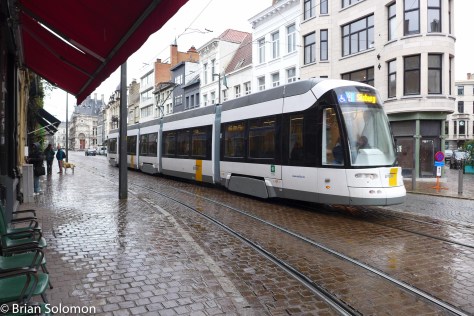
A modern Flexity2 tram glides through the rain in Antwerp. Lumix LX7 photo.
Complicated track work makes for a more interesting urban image.
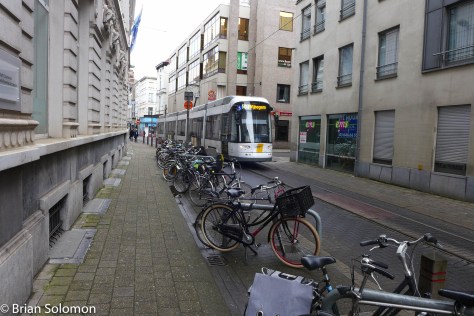
Complicated track work makes for a more interesting urban image. The PCC is almost incidental to the scene.
There are plenty of eclectic establishments in Antwerp where you can grab a bite to eat an enjoy a glass of beer while watching the tram cars grind along cobblestone streets.
Antwerp enjoys a complex transport system with tram lines on many streets. However, expansion of the tram subway may soon reduce the number of surface services in some parts of the city center.

Lijn_Antwerp_P1450608

Could a bus be as photogenic in such a setting?

Lijn_Antwerp_P1450638

Among the advantages of photographing on a cold wet day is that there tend to be few people on the streets to get in your way. Not to be antisocial, but masses of urban humility can be a problem when composing tram photos.
Among the advantages of photographing on a cold wet day is that there tends to be few people on the streets to get in your way. Not to sound  antisocial, but masses of urban humility can be a hindrence  when composing tram photos.

Lijn_Antwerp_P1450622

Near the main railway station there's a tram loop.
Near the main railway station there’s a tram loop used by route 11 cars.
This level crossing is a great place to catch the action.
I don't think everyone was quite as enthusiastic about tram tracks and cobblestones as I was.
I don’t think everyone was quite as enthusiastic about tram tracks and cobblestones as I was.

Lijn_Antwerp_P1450668

Curbside running makes it easier to board the cars.
Here's my car now!
Here’s my car now!

Lijn_Antwerp_P1450674

White trams navigating narrow dark cobble-stone streets makes for some interesting contrast. So, would shafts of sun have improved these images?

Tracking the Light posts every day.


Ringling Brothers and Barnum & Bailey Circus Train on Washington Hill—May 16, 2016.

It was very windy, and I spent the whole morning standing around along the old Boston & Albany mainline reading about 19th century industrial practice while waiting for trains to pass.

I posted the photos I made of an eastward Norfolk Southern detour train near Middlefield, Massachusetts yesterday evening.

My goal was to catch the Ringling Brothers and Barnum & Bailey Circus Train, that was rumored to be on the move.

But, after 8 hours standing in the cold, I decided to head downgrade.

Nearing Westfield, the scanner came to life, ‘clear signal CP109’.

Time for a U-turn.

I’d scoped a location near Huntington.

Unfortunately this neatly coincided with a fast moving cloud. Bad luck.

A dark dirty cloud covered the sun at precisely the wrong moment. (It lifted in time for me to grab a wide-angle view on Fujichrome.)

CSXT_Circus_Train_DSCF7561

A bit of hard driving got me to Washington Summit ahead of the train. The clouds stayed at bay.

All of these images were exposed with my FujiFilm X-T1 mirror-less digital camera.

Slides from the event remain latent.

Near Washington Summit at the location known as 'Muddy Pond'.
Near Washington Summit at the location known as ‘Muddy Pond’.
The Ringling Brothers and Barnum & Bailey Circus Train is a long consist.
Containers and trailers were at the back.

Tracking the Light is Daily!

Tracking the Light NEWS EXTRA! NS/Pan Am Southern Detour on CSX Boston Line.

This morning (May 16, 2016), I was out on the Boston & Albany (CSX Boston Line) for the Ringling Bros circus extra. While waiting word came over the wire that a Norfolk Southern intermodal train for Ayer, Massachusetts was detouring on CSX.

A derailment near Charlemont, Massachusetts (on NS/Pan Am Southern’s Boston & Maine route) on Saturday resulted in a traffic disruption and thus this very unusual move.

A CSXT SD40-2 led the Norfolk Southern consist, presumably because of the cab signaling requirements on the Boston Line .

All photos exposed with my FujiFilm X-T1 near milepost 129 east of Middlefield, Massachusetts.

CSX_X800_Middlefield_NS_detour_DSCF7527CSX_X800_Middlefield_NS_detour_DSCF7529CSX_X800_Middlefield_NS_detour_DSCF7530Tracking the Light posts Daily!

Circus Train photos tomorrow!

Hidden Treasures: Preserved Locomotives at Saint Ghislain, Belgium; Don’t miss Brian’s Exposure Guide for old Locomotive sheds.

Locked away in an old locomotive shed at Saint Ghislain, Belgium are a wonderful collection of historic SNCB locomotives maintained by Patrimoine Ferroviare et Tourisme. See: http://www.pfttsp.be/index.php/fr/

Mauno Pajunen organized a visit to this collection and provided translation while Rousman Phillippe offered a guided tour.

I was most impressed by the semi-streamlined stainless-steel clad electric (SNCB 1805) that formerly worked TEE international services and by the Baldwin diesel locomotive built under license.

Until my visit the to the shed at Saint Guislain, I'd only seen this class of locomotive in old photos. The pitched cab profile and stainless-steel side panels are very pleasing. They just don't style locomotives like this anymore!
Until my visit the to the shed at Saint Guislain, I’d only seen this class of locomotive in old photos. The pitched cab profile and stainless-steel side panels are very pleasing. They just don’t style locomotives like this anymore!

SNCB_historic_loco_Saint_Ghislain_DSCF6294

Photographing in a locomotive shed such as this one requires special technique.

If you just let the in-camera meter do the work you will get under-exposed (dark) images such as this. Why? Because the camera meter is trying to balance the scene for the window which leads to overall under-exposure. Action on the photographer is necessary on-site to avoid this problem.

Direct and indirect lighting from skylights in the roof and large side windows results in extreme contrast with lower regions of the locomotives bathed in darkness that tends to confuse the in-camera light meter. (A meter doesn’t know what your subject is and only provides a balanced reading and doesn’t work in this situation.)

If you are not careful you may end up with an unacceptably dark result. (see above).

By manually controlling the exposure you can compensate for the effect of windows and skylights, thus creating a more pleasing exposure inside the shed.

My solution is relatively simple: manually over-expose in range of 2/3s of a stop to 1 stop, and then control highlight detail in post processing.

The easiest way to do this with a digital camera is used a manual mode and then watch the suggested exposure settings offered by the built in meter and then add 2/3s to 1 stop to the recommended value. Thus if the meter suggests exposing a f2.8 at 1/60th of second, open up the aperture to nearly f2.0 without changing the shutter speed.

Another way of doing this is by adjusting the meter to over expose by 2/3 or 1 full stop. Each camera has its own means of doing this.

In my case, I set the ISO to 400, so my average exposure was f4.5 1/60 of a second (camera meter was recommending f5.6 to f6.3, which would have resulted in an unacceptably dark image).

SNCB_historic_loco_Saint_Ghislain_DSCF6338

I adjusted my exposure from scene to scene, while tending toward overexposure based on the meter setting and carefully gauging the histogram to avoid loosing data in the shadow areas.

SNCB_historic_loco_Saint_Ghislain_DSCF6316

Since the highlights of the outside windows and skylights are not important to the overall scene, it isn’t a problem to allow for a loss of detail in these areas.

After exposure, I adjusted the files in post-processing to bring the mid-tones and shadow areas to an expected level.

SNCB_historic_loco_Saint_Ghislain_DSCF6319

This was one of my favorites: a Baldwin diesel built under license. Careful exposure allowed for adequate detail of the trucks and underbody.

SNCB_Baldwin_historic_loco_Saint_Ghislain_DSCF6300

The boiler was outside.
Wide angle close up of Walschearts valve gear. Old Egide was a Belgian after all!

SNCB_historic_loco_Saint_Ghislain_DSCF6314

Another trick is working in confined spaces. For these images I used a super wide-angle lens, specifically a Zeiss 12mm Touit, which I purchased specifically for photography in settings such engine sheds, signal towers and locomotive cabs.


Tracking the Light Posts Daily.


The end of the line for SNCB! A Dozen photos at Quiévrain.

International borders are often bad for railways.

An invisible political boundary (the dashed line on a map) can prove a greater obstacle than a towering mountain range when it comes to impeding railway operations.

In mid-April, my Irish friends and I explored the Gotthard Pass, where massive investment will soon make the old line over the mountain redundant as the new 35.5 mile Basistunnel beneath the Alps will divert most of the through traffic.

A week later I was exploring the border area between northern France and Belgian Wallonia with Mauno Pajunen.

This is in an area of relatively dense population that was once the center of a thriving coal mining community. Quiévrain, Belgium is a town located an hour or so from Brussels and is relatively near to large French cities of Lille and Paris.

The tree growing out of the roof of the old station is indicative the sad state of the railway here.
Despite the poor state of the facilities, SNCB continues to provide a relatively frequent passenger service to Quiévrain. Electric trains offer an inexpensive and comfortable way to travel to Mons and Brussels where connections are available to many other cities across the country.

Generally speaking SNCB (Belgian National Railways) provides an excellent service across Belgium, with most stations seeing at least an hourly passenger service and many lines operating with an even greater frequency.

Lumix LX7 photo.
Lumix LX7 photo.

At one time a through railway line connected Belgian cities of Brussels and Mons with the French city of Valenciennes via Quiévrain . Today, SNCB continues to operate a regular interval passenger service from Brussels to Mons with some trains continuing south to Saint Ghislain and Quiévrain.

But Quiévrain is the end of the line and the state of the station area is a sad reflection of better times now long gone.

This was once a handsome station.


Evidence of the old line remains and the tracks are still in place (although no longer connected).

The town is divided between Belgium and France, with the French town being called Quiéverchain. Differences in the price of tabacco and alcohol between the two countries has led to a thriving business on the Belgian side of the border.

Here we are at the French-Belgian frontier which divides the town of Quiéverchain/Quiévrain. Good luck getting through the place by rail!
Oh dear! The connecting stink buggy has arrived.
SNCB provides excellent signage at stations.

It had been many years since you could take a train directly from Mons to Valencienes.

In theory, you can ride from Brussels to Valenciennes via a change of trains at Lille, but this is the long way around and impractical for regular travelers.

The end of the line for SNCB! (but the tracks once continued into France.)

SNCB_Quievrain_P1450197

Elsewhere in Europe cross-border services have flourished, yet the end of track at Quiévrain clearly demonstrates how borders create barriers between population centers that need not exist.

Soon you will be able to travel faster than ever before from Zurich to Milan, but not by rail from Mons to Valenciennes!

Only a short walk from the end of track will reveal the old line that once continued across the border. A ghost from another era.
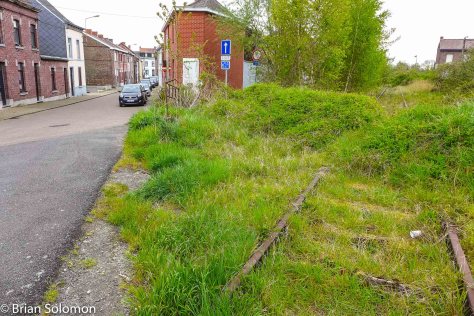
Only a short walk from the end of track will reveal evidence of the old line that once continued across the border. A ghost from another era.
I find disused railways sad, yet fascinating. Like discovering evidence of a forgotten empire.

SNCF Valenciennes‑Revisited (April 2016). Six NEW photos.

Last October (2015), I visited Valenciennes in northern France. I stopped by again a few weeks ago during my April 2016 wanderings in France and Belgium.

Valenciences_station_DSCF6244

Valenciences_Station_w_tram_DSCF6240

In these views I focused on the old Chemin de fer du Nord Station (SNCF’s Gare de Valencienes) and the surrounding environment.

Using my FujiFilm X-T1, I made images that feature the old station as both subject and background. Notice how selective focus and use of light shifts the central interest from the old building to the tram.

SNCF_Gare_Valenciences_DSCF6278

Outback of the station, there are, of course, SNCF trains and an impressive array of trackage that make interesting subjects in their own right.

Together, the building, trams, SNCF trains and trackage make for a scene, but one not possible to adequately represent in one image. Thus this myriad collection of images. This is a work in progress.

SNCF_Valenciences_DSCF6269

An SNCF train approaches Gare de Valenciennes.

Tracking the Light posts every day! (Have you noticed?) 

Tracking the Light Extra: Rochester, New York—Conrail Shadow.

Some photos age well.

The purpose of this image was intended as a test of Kodak's new T-Max 100 black & white film. Exposed with a Canon A-1 with 50mm lens.
The purpose of this image was intended as a test of Kodak’s new T-Max 100 black & white film. Exposed with a Canon A-1 with 50mm lens.

I made this view of Conrail GP40-2s rolling east at Rochester, New York’s  Amtrak station in November 1986—nearly 30 years ago.

At the time, Conrail was the order of the day, and the GP40-2s were common.

Although sharp and properly exposed, this view was marred by the shadow of the canopy and so at the time I disregarded it.

I’ve amended my opinion, however.

Now the whole scene has changed beyond recognition. Conrail is gone nearly 17 years and last year Amtrak demolished its old station in preparation for construction a new one.

Tracking the Light posts daily.

Strasbourg: 10 photos of Low Floor Trams in a Sophisticated European City


Strasbourg_Tram_P1440893It was a pleasantly warm Spring day when I set out with Lumix LX7 in hand to make a few photos of the Strasbourg trams.

Strasbourg was among the first French cities to re-adopt the electric tram, and in 1994 introduced an elegant modern tram system using a pioneer type of low-floor car (the first batch were  built by ABB) called the Eurotram.

I’ve been meaning to visit Strasbourg for a long time, but only recently managed to finally get there.

Any favorites from this selection?

Among my first fews of the Strasbourg tram system. Notice the rail-mounted cleaning truck in the distance.
Among my first views of the Strasbourg tram system. Notice the rail-mounted cleaning truck in the distance.

Strasbourg_Tram_P1440907

Contrast of old and new.

Strasbourg_Tram_P1440934

Like with many modern tram systems, in Strasbourg you must validate your paper ticket before boarding the car. I noted teams of fare enforcement specialists intimidating non-paying passengers.
Strasbourg offers many places to include the trams in attractive cityscapes such as this one.
A few of the cars were painted in this lime, red and white livery.

Strasbourg_tram_P1440885Strasbourg_Tram_P1440951

Railway photography by Brian Solomon